Larry Hosken: New: Tag: yeah-i-care-about-nutrition

Book Report: Frostbite

It's a book about food preservation.

It's mostly about refrigeration; that's because in recent decades, developed countries concentrated on refrigration, setting aside research into other methods. When refrigeration first came along, consumers didn't really trust it: Who would dare to drink old milk just because it'd been stored in one of those newfangled noisy boxes? Generations later, we have the opposite problem. If someone figures out another way to preserve some kind of food, consumers might not trust that food to stay good if it hasn't been kept cold. It doesn't make sense for a grocery store to sell soy milk from its dairy case—until you consider that a considerable fraction of consumers balk at the idea of room-temperature "milk."

Our refrigeration system is pretty impressive. Reefer trucks haul things between refrigerated warehouses. Specialized workers have learned to get things done in cold storage; but not try to do too much as the cold is bad for bodies, bad for brains, bad for reaction time to avoid crashing. Cold is bad for our defenses against disease; our noses don't defend as well against diseases if those noses are nearly freezing.

The book covers a lot of ground. Some bits that struck me:

A lab where they develop suits for working at extreme temperatures.

In a test chamber with us, suspended from a sturdy metal frame, was a life-size gray manikin wearing a black woolen hat, a navy-blue turtleneck, dad jeans, Velcro sneakers, and a pair of mittens.

"Here's one of our thermal sweating manikins," said [North Carolina State Univeristy Thermal Protection Lab deputy director Shawn] Deaton. "This one has a breathing mechanism, so we call him Darth Vader. The other one is Anakin the Manikin, and of course we have Hand Solo for gloves."

(The book didn't explain the difference between a mannequin and a manikin, so I had to look it up. If it's for displaying fancy clothes, it's a mannequin, spelled like "quinceañera gown." If it's in a lab to measure what happens if, say, clothes are set on fire, it's a manikin, spelled like "kindling.")

The logistics of food transport get weird:

In nonpremium brands, a pint of ice cream is, on average 50 percent air. This leads to all sorts of logistical complications. National brands of ice cream have to use different formulations for different regions to take into account the thinner air at higher elevations. "You can't truck it from Washington to Georgia," Espinoza told me. "The Rockies, he explained, shaking his head.

Why do Americans put so much corn syrup/sugar in everything? Probably partly because we drink so many ice-cold beverages.

At least three of our basic taste receptors—sweet, bitter, and umami, or savory—are extremely temperature sensitive. When food or drinks cool the tongue to below fifty-nine degrees, the channels through which these three taste receptors message the brain seem to close up, and the resulting signal is extremely weak. This is why a warm Coca-Cola or a melted ice cream is so sickly sweet: because they're intended to be consumed cold, they have to contain too much sugar to boost the signal and register in our brains as tasting sweet at all. In 1929, the president of Coca-Cola set up the Fountain Training School to ensure the drink was being prepared and served properly: salesmen were told, "It's gotta be cold if it's gonna be sold."

Those gross Jell-O/whipped cream "salads" may have started out as status signifiers, back when household refrigerators were novel.

Why is it a shame that developed countries went whole-hog for refrigeration, while letting other food-preservation methods languish?

Refrigeration contributes to rising greenhouse gas levels in two main ways. Generating the power to run cooling equipment, whether it be elictricity for warehouses or diesel fuel for trucks, already accounts for more than 8 percent of global electricity usage. (Cold-storage companies are currently the third highest industrial consumers of energy.) Using renewable sources to generate that power would help, but solar-, wind-, geothermal-, and hydro-power generation are growing much too slowly to keep pace with demand. …

The other problem is the refrigerants themselves: the chemicals that are evaporated and condensed by compressors in order to remove heat and thus produce cold. Some of that refrigerant leaks into the atmosphere as a gas—either a little (roughly 2 percent a year from thee most up-to-date domestic refrigeratrs) or a lot (a third, on average, from small delivery trucks). Different refrigeration systems use different refrigerants, some of which, like ammonia, have a negligible global-warming impact. Others like the hydrochlorfluorocarbons and hydrofluorocarbons (HCFCs and HFCs) that are popular in the developing world…are known as super-greenhouse gases because they are thousands of times more warming than CO2.

Before I read this book, I figured the best thing we could do for developing nations was help them set up a cold chain; now I wonder if we should work harder on other ways to preserve food. Pickles are nice. Who doesn't like pickles?
Permalink

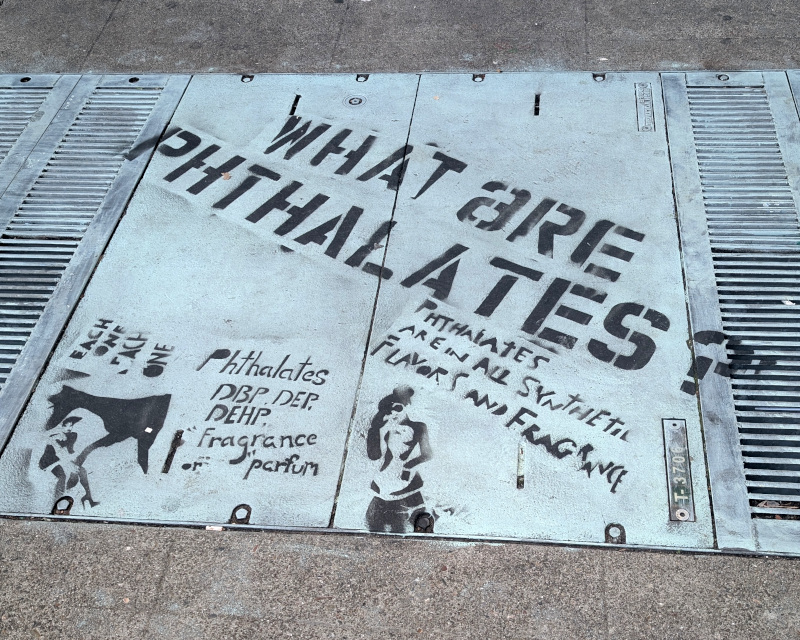
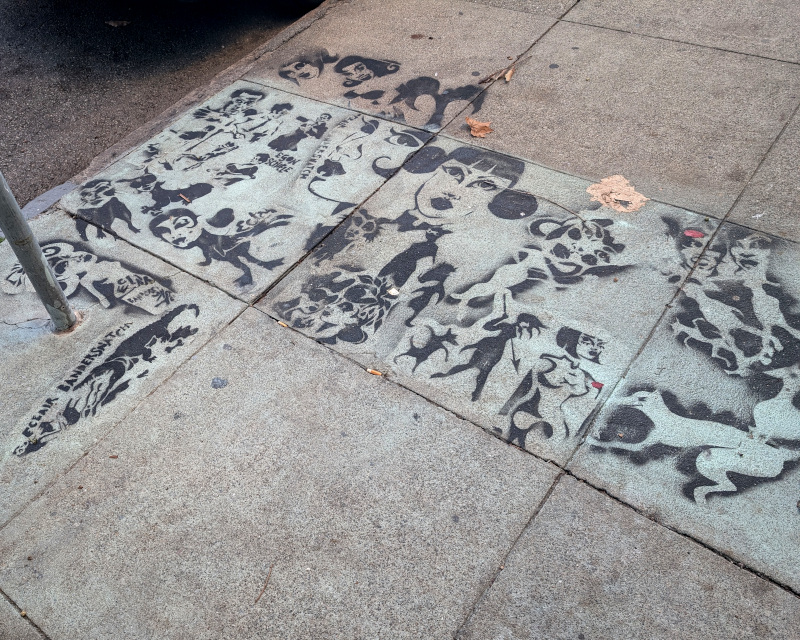
Stencil artist Eclair Bandersnatch knows that it pays to increase your word power. Consider phthalates: if these chemicals are good for softening PVC plastic, maybe they can also soften your bones? The best way to find out is through experimentation, perhaps by eating microplastics or absorbing phthalates that are in cosmetics for some weird reason?

sidewalk stencil graffito on metal, maybe an underground utility thingy cover? there are some human and animal figures and some text. The text: What re phthalates? Phthalates are in all synthetic flavors and fragrance. Each one teach one. Phthalates DPB DEP DEHP ''Fragrance `'parfum sidewalk stencil graffiti. Lots of human and animal figures. The humans tend to wear makeup: lipstick, mascara. there are some inverse-drawings, in which the figure is the absence of paint, a technique well-suited to stencils

Permalink

As Hallowe'en approaches, some of the seasonal displays at the grocery store give mixed messages. It's not wrong, but it might make more sense above the yogurt instead of the strawberries. ...

Permalink

Nabisco workers are on strike. A few weeks back, Frito-Lay workers were on strike. I appreciate that they didn't all strike at the same time, enabling me to maintain 100% snack uptime. ...

Permalink

I'm making latkes from my grandmother's recipe. It's written down on a 1964 calendar page inserted into my mom's recipe book. I guess I should copy it out here so I can find it be searching teh inter...

Permalink

They're not exactly self-fulfilling prophecies, but they're self-something somethings. I got an electric hot-water kettle. I'm just that lazy, I wanted it to be easier to boil water; it seemed extra...

Permalink

Link: new Dead Milkmen album Fogeypunks and humorees of a certain age might remember The Dead Milkmen from back in the day. They have a new album out. I haven't listened to the whole thing, but "Caitlin Childs" and "Meaningless...

Permalink

Comic Report: Burger Force The premise doesn't sound promising, but oh man did I like Burger Force. Hapless youth joins an elite spy network with groovy 70s design that operates out of a secret base underneath a fast food rest...

Permalink

Supermarkets vs museums. Curated peaches are near the artisanal cereals in aisle six Since when does stocking a store - any kind of store - count as “curating?” –things consumed A lo...

Permalink

Book Report: Mountaineering in the Sierra Nevada Good writing can help your work's longevity. But it doesn't fix everything. Mountaineering in the Sierra Nevada is a well-written book. It's from 1872. Charles King was a good writer. But... it ...

Permalink

Link: Two Narrow Establishments in the Inner Sunset My neighborhood has a hot dog shack: Underdog. It's at around 18th Ave and Irving. I like it, and suspect that my foodie friends might like it, too. They might not trust my judgement, of course. ...

Permalink

Book Report: On Food and Cooking Here is the recipe I follow for tamales: 1. remove two tamales from package. 2. place in pot with steamer rack 3. place on high heat 4. get distracted by computer stuff, lose track of time 4. when ap...

Permalink

Site Update: Food Photos That day when I ate at all of the cafeterias at work (a few weeks ago), I brought along a camera, yay! Uhm, but I ran out of batteries early on and I hadn't brought any spares, whoops. So I emerged...

Permalink

Not-exactly Puzzle Hunts are Everywhere Item: Saturday, I wanted to vote, so I walked through the Haight and down to City Hall. In the Haight, I noticed some young folks in matching t-shirts scurrying around. So I observed and eavesdroppe...

Permalink

Link: Steven Pitsenbarger on Anthotypes Steven Pitsenbarger writes about making pictures of plants from their own juices. And that, children, is why you should never leave your salad out in the sunlight all day. It will become part of yo...

Permalink

Book Report: Lunch Lessons Those Debian install CDs showed up. Fortunately, I have two computers. So here I sit, typing on the laptop-- uhm, excuse me. OK, I'm back. Here I sit on the laptop, occasionally pausing to swap C...

Permalink

Book Report: Dishwasher Dave Hill wrote in to say that he'd been reading some of my old web pages. (He didn't say so, but he probably started browsing because he was hoping to see some kind of writeup about the the No More...

Permalink

Book Report: BAE05: Ellen Ullman's "Dining with Robots" The Best American Essays 2005 contains two essays which pay homage to the then recently-deceased chef Julia Child. One of them is by Ellen Ullman. Ellen Ullman is a geek; she writes about software ...

Permalink

Book Report: Garlic and Sapphires I am basically over my cold, but the sore throat remains. Thus, I wanted soup. Citrus Club, a soup place on the Haight, was closed. I guess they wanted to enjoy their holidays or something. So I ...

Permalink

Book Report: The Man Who Would Be King A U.S.A. citizen went to Afghanistan and got mixed up in the local wars and politics. In the 1830s. This is his story. Ben MacIntyre wrote this book about Josiah Harlan, foreign meddler. Unfortuna...

Permalink

Book Report: Consider the Oyster Holy moly, M.F.K. Fisher sure could write. I don't want to eat oysters, but I could read Fisher's writings about oysters all day. Except I can't really, because this was just a short little book. ...

Permalink

Book Report: Something From the Oven Laura Shapiro wrote this awesome book about home cooking in 1950s USA. There are many interesting stories here. There is the tragic tale of Poppy Cannon who tried to convince the world that canned t...

Permalink

Tags